
Ultrafiltration systems are water treatment techniques designed to remove microscopic contaminants from water.These systems rely on membrane technology with very small pores that act as a physical barrier against large molecules and compounds. Ultrafiltration systems are commonly used in residential, commercial, and industrial applications thanks to its cost effective nature.
What is Ultrafiltration Systems?

Ultrafiltration (UF) systems are advanced water treatment technologies that use semi permeable membranes to remove bacteria, viruses, and some macromolecules from water. These systems operate under pressure, forcing water through membranes with very fine pores. These pores have dimension from 0.01 to 0.1 microns. In contrast to conventional filtration, ultrafiltration can easily remove much smaller contaminants.
Ultrafiltration (UF) Systems Advantages
Ultrafiltration systems has some several important advantages:
- High removal efficiency: Capable of eliminating bacteria, viruses, and smaller compounds.
- Chemicalfree process: Does not need any chemical.
- Consistent water quality: Can provide stable and reliable water
- Compact design: Systems can be installed at any place.
- Energy efficiency: Operates at lower pressures compared to other membrane technologies.
- Environmentally friendly: Produces minimal waste.
How Does Ultrafiltration Work?
Ultrafiltration works by applying pressure to push water through a semipermeable membrane. The membrane holds the contaminants in the water:
- Water enters the system under pressure.
- Water passes through the membrane pores, allowing only small molecules like water and dissolved salts to pass.
- Contaminants are retained on the membrane surface.
- Filtered water is collected, while the retained contaminants are flushed away as waste.
What Does Ultrafiltration Remove?
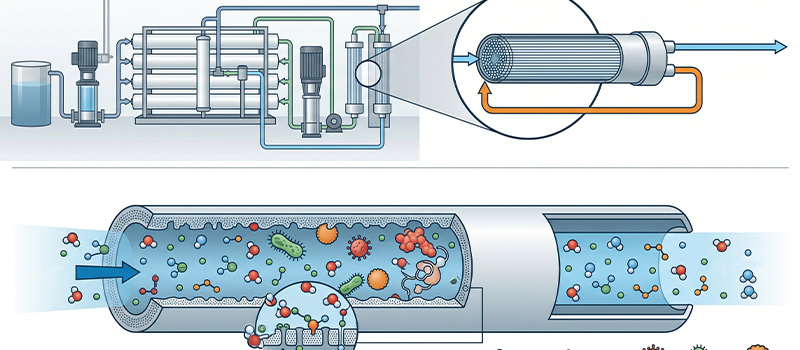
Ultrafiltration systems are membrane based water purify systems and they are highly effective at removing:
- Suspended solids
- Bacteria and viruses
- Fine particles
- Some proteins and organic macromolecules
But, ultrafiltration does not typically remove dissolved salts, minerals, or very small organic molecules. These contaminants are only removed by technologies like reverse osmosis.
Key Features of Ultrafiltration Membranes
Here are the core characteristics of ultrafiltration membranes:
- Pore size: Extremely small
- Material composition: Generally made from polymers
- High permeability: Enables water flow with low pressure
- Durability: Resistant to chemicals
- Backwash capability: Many membranes can be cleaned and reused
Is There A Difference Between Filtration and Ultrafiltration?
Yes, there is a significant difference:
- Conventional filtration removes larger particles like sand, and debris. Typically they use carbon filter.
- But ultrafiltration, targets much smaller contaminants, including microorganisms and fine colloids. Ultrafiltration uses membrane technology.
Basically, ultrafiltration is a more precise and advanced form of filtration.
Applications of Ultrafiltration in Industries
Ultrafiltration systems are widely used across various industries:
- Water and wastewater treatment: Producing potable water.
- Food and beverage: Clarification of juices.
- Pharmaceuticals: Ensuring sterile water.
- Chemical processing: Purifying solutions.
- Power plants: Pretreatment for boiler feed water.
Comparison with Other Filtration Methods
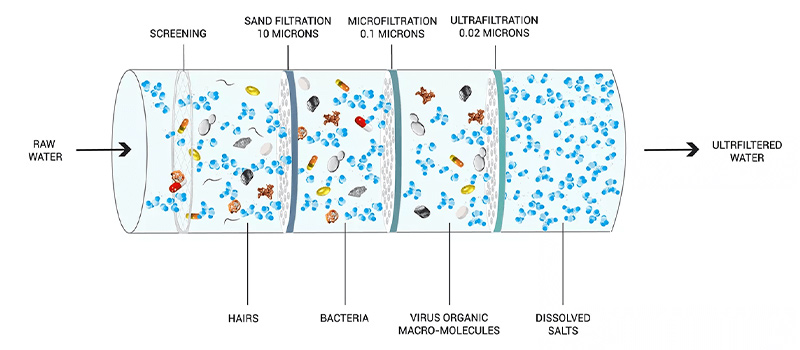
Ultrafiltration performance is between microfiltration and reverse osmosis. Its removal efficiency is lower than nanofiltration. You can see the table below:
| Organic Molecules | Bacteria | Virus | Fine Particles | Dissolved Salt | |
|---|---|---|---|---|---|
| Microfiltration | – | + | – | – | – |
| Ultrafiltration | – | + | + | + | – |
| Nanofiltration | + | + | + | + | – |
| Reverse Osmosis | + | + | + | + | + |
Compared to reverse osmosis, ultrafiltration requires less energy and maintenance but offers less advanced treatment of water.
How Do You Maintain An Ultrafiltration System?
Proper maintenance is essential for longterm performance:
- Regular cleaning: Includes backwashing and chemical cleaning to prevent clogging
- Monitoring pressure and flow rates: Helps detect membrane blockage or damage
- Periodic membrane inspection: Ensures integrity and efficiency
- Pretreatment of feed water: Reduces contaminants and extends membrane life
- Scheduled replacement: Membranes have a limited lifespan and must be replaced when performance drops.
With proper care, ultrafiltration systems can work for many years.